
MHAIRI REVIE, 2022
Herring tins, Sardine tin, Archival paper, Charbonnel aqua wash ink, Drawing materials, Binder medium
3 miniature books:
5 (L) x 5 (W) x 1 (H) cm
5 (L) x 2.5 (W) x 3 (H) cm
12 (L) x 4 (W) x 5 (H) cm
About the artwork…
The work represents both a play on words, and a playfulness in the use of materials. I intend making a small series of concertina books of miniature drypoint etchings, drawings and localised limericks. The individual etching plates will be made from the tin lids of herring cans, with the images focusing on species introduced into the colony: rabbits, deer and foxes. These tiny works will be book-ended with the herring tin lids as covers.
The term, ‘red herring’ means false clue, decoy or distraction. Its first use in this context can be found in the late 1600’s, referring to an effective means for extending a fox hunt, with the lure of strong-smelling fish being used to distract the hounds from chasing rabbits. As diversionary tactics go, red herrings are typically designed to be logical fallacies: seemingly plausible, yet deceitfully paradoxical. In context of this work, books that are books but also tin cans can be seen as red herrings in themselves. A further red herring can be found in the layered approach of this work: it is playful, but at the same time more seriously representative of the nuances which can be found in the persistence of local (and indeed broader) social and environmental practices introduced into colonial societies.
About the artist…
I developed an interest in art practice in the mid-1980s to early-1990s when I regularly practiced life drawing, linocut and silk screen printing, drawing and portraiture. Through subsequent employment in government, I have acquired considerable competency in developing and supporting often arts-based programs responding to community need, as well as forming guidelines for public art at local government level. In 2005 I completed a Master of Public Policy & Governance through Deakin University, formalizing knowledge of community cultural development, and the mechanisms for generating projects. In my current return to art-making I am inspired by the representation of the natural environment: contours and bathymetry; geography/mapping; natural river behaviour, including the various interactions between rivers and the natural and built environments in which they exist; and our native as well as introduced flora and fauna. Equally my art-making is inspired by a deep interest in sociocultural representations of our social environment, including gender, linguistics (inclusive of pragmatics and etymology) and the role of society in disaster causation. My current arts practice focuses primarily on printmaking (linocut and etching), drawing, collage and mixed media.

MOUSEHAMMER, 2022
tea tins, coat hanger wire, 2 cent pieces, plastic spacemen, sundry metal doo-hickeys, foil, paint, glue, whimsical alt-history newspaper article (A4 in a frame)
40 x 40 x 40 cm
About the artwork…
From the 4 July 1881 edition of the Western Exaggerator:
“In news to hand Tasmanian explorer James “Philosopher” Smith plans to mark the success of his latest enterprise by attempting something that even the Greats of Empire have not. “We choose to go to the Moon” he said “for Tea. Our ship, the ‘TINMAN’, is levitated by virtue of the mineral Cassiterite. The interaction of the diamagnetic properties of the crystal with the Earth’s magnetic field propel the ship. We have discovered that it is strongly activated in the presence of sonic waves, particularly the human voice. Young singer Helen Porter Mitchell (aka Nellie Melba) has agreed to join the grand adventure. An ancient proverb says ‘The path to Heaven passes through a teapot’” Smith continued “In our case we will pass through the Heavens for a cup of “the brown”. This trip will surely prove to the World that Tasmania has the right stuff”
About the artist…
mousehammer is a northern tasmanian artist working in steampunk retro-futurist nonsense. computer meddled-photography, bits of text, bricolage and the machinery of a past that never was.
ANNE YOUNG, 2022
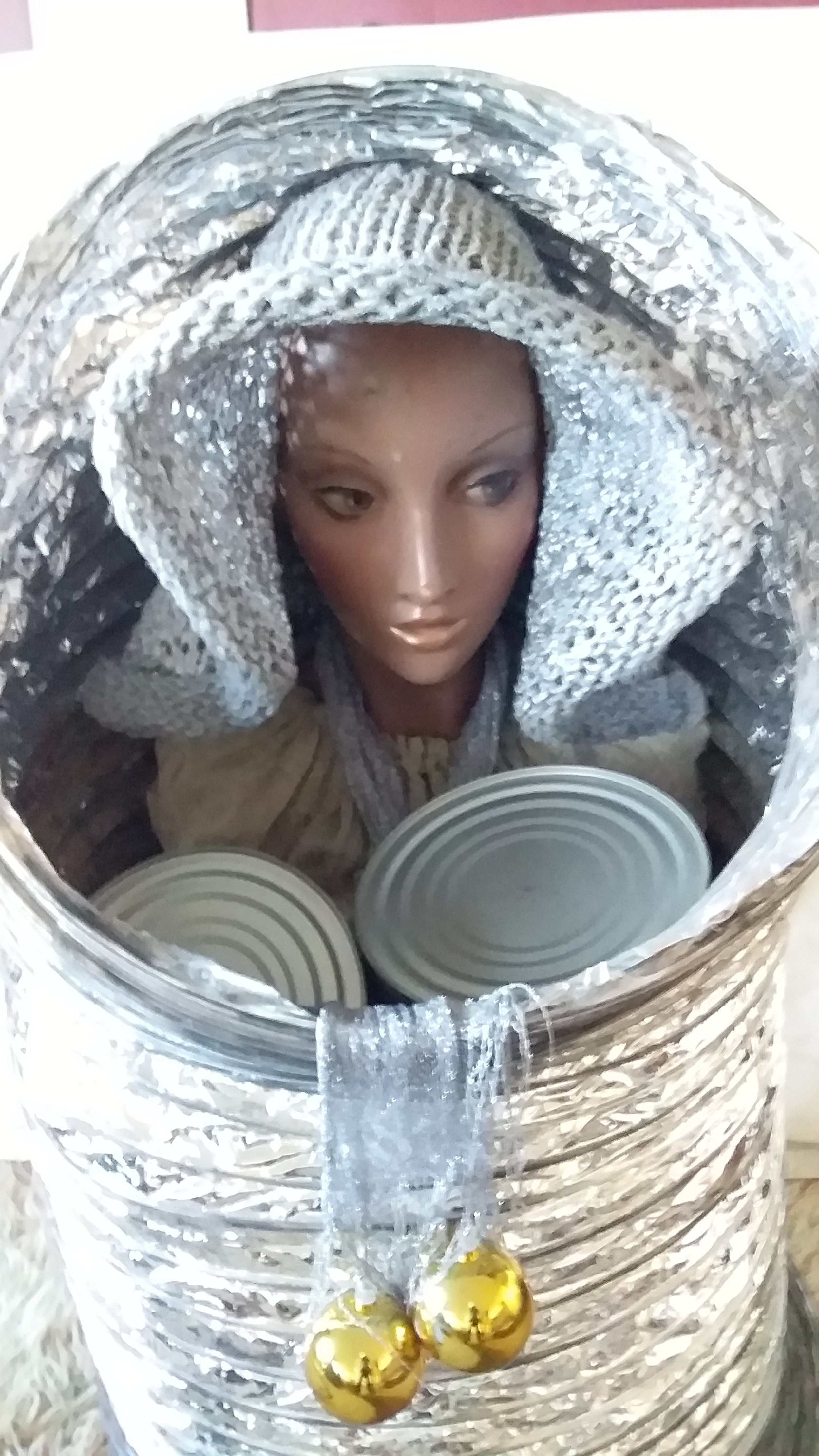
Ducting, tin cans, hand knitted hat.
80 x 40 x 40 cm.
About the artwork…
Anne Young has always been fascinated by making something out of anything, letting her mind flow “Outside the Square.” The piece of ducting found at the Beaconsfield tip seemed to lend itself to the realm of tin cans, and has become protection for her model as she nestles there with her tin cans.
About the artist…
Anne Young has fulfilled a creative dream once emigrating from Scotland to Mount Isa with a young family in 1966. She looks on Australia as indeed the land of opportunity, achieving an Associate Diploma in Fine Arts (Textiles) in 2001, and completing an Associate Degree in Arts 9 years ago which included some theatre electives.
HELENA GRIFFITH, 2022
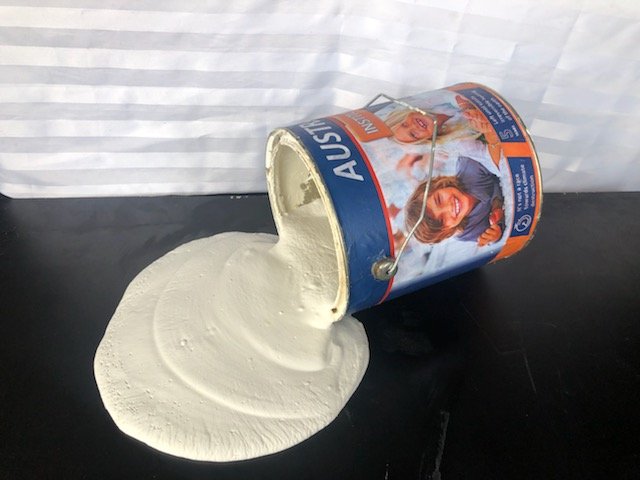
Recycled paint tin, paper, glue, plaster of Paris and acrylic paint.
20 x 20 x 40 cm.
About the artwork…
June 19th 2022 in the peaceful NSW river town of Colo, a property was raided by police under the guise of it being deemed a ‘crime scene’. 48hrs of police searching ensued, during which tents were damaged, car windows smashed, and tins of paint emptied onto Dharug country. The property was a home and camp to environmental activists, who were at the mercy of ‘anti-protest’ laws that were introduced one month prior, variations of which have since been introduced here in Tasmania. Eight activists were arrested on the day of the raid two of which spent three and a half weeks in prison, their crime? Planning to protest. A further 32 people were arrested for participating in protests in the fortnight that followed, all of which are being charged under the NSW ‘anti-protest’ bill, which could have them sentenced up to 2 years in prison and $22,000 in fines.
About the artist…
Born in and raised in rural NSW, Helena moved to Tasmania in 2018 to study Environmental Science at UTAS. Her passion for nature and the outdoors led her to first take part in activism with groups such as The Bob Brown Foundation, calling for the protection of Tasmania’s Wilderness. The first half of 2022 found Helena residing in Sydney NSW, with a group of fellow activists, organising protests that call for the much-needed systematic changes required to stop the climate injustices that Australia and its institutions are harbouring. The introduction of the anti-protest laws is just another example of such injustices. All profits made from the sale of this piece will go towards environmental activism in lutruwita/Tasmania.

MAUREEN KINGSLEY, 2022
Auminium Milo can...
30 x 20 x 20 cm.
About the artwork…
2021, what a year! Like a Jack in the Box turned Jumanji, the ‘2021 in a can’ toy is totally unpredictable. Cautiously turn the handle, because you never know just when the the lid will fly off or what will jump out! 2021 and COVID - everyone had an opinion, some crazier than others. It was an absolutely unpredictable year. The planes stopped, streets were quiet, people were told to stay home. We waited for daily press updates, vaccines and toilet paper supplies. People stopped learning, stopped earning and stopped breathing. A few saw opportunity, with increased profits as housebound folk got bigger tellys and undertook home renovations. These same few were rewarded with a mega-bonus called jobkeeper. We had an incompetent Prime Minister who, unable to manage one job, sneakily named himself captain of nearly everything else. People lost their lives, and their loved ones. Weddings were postponed, holidays were cancelled. Funerals went ahead, lots of funerals. Without mourners. No hospital visits, no final goodbyes. 2021 in a can, I’m glad you’re done!
About the artist…
Maureen Kingsley. 1961 - current.
CATHERINE PHILLIPS, 2022
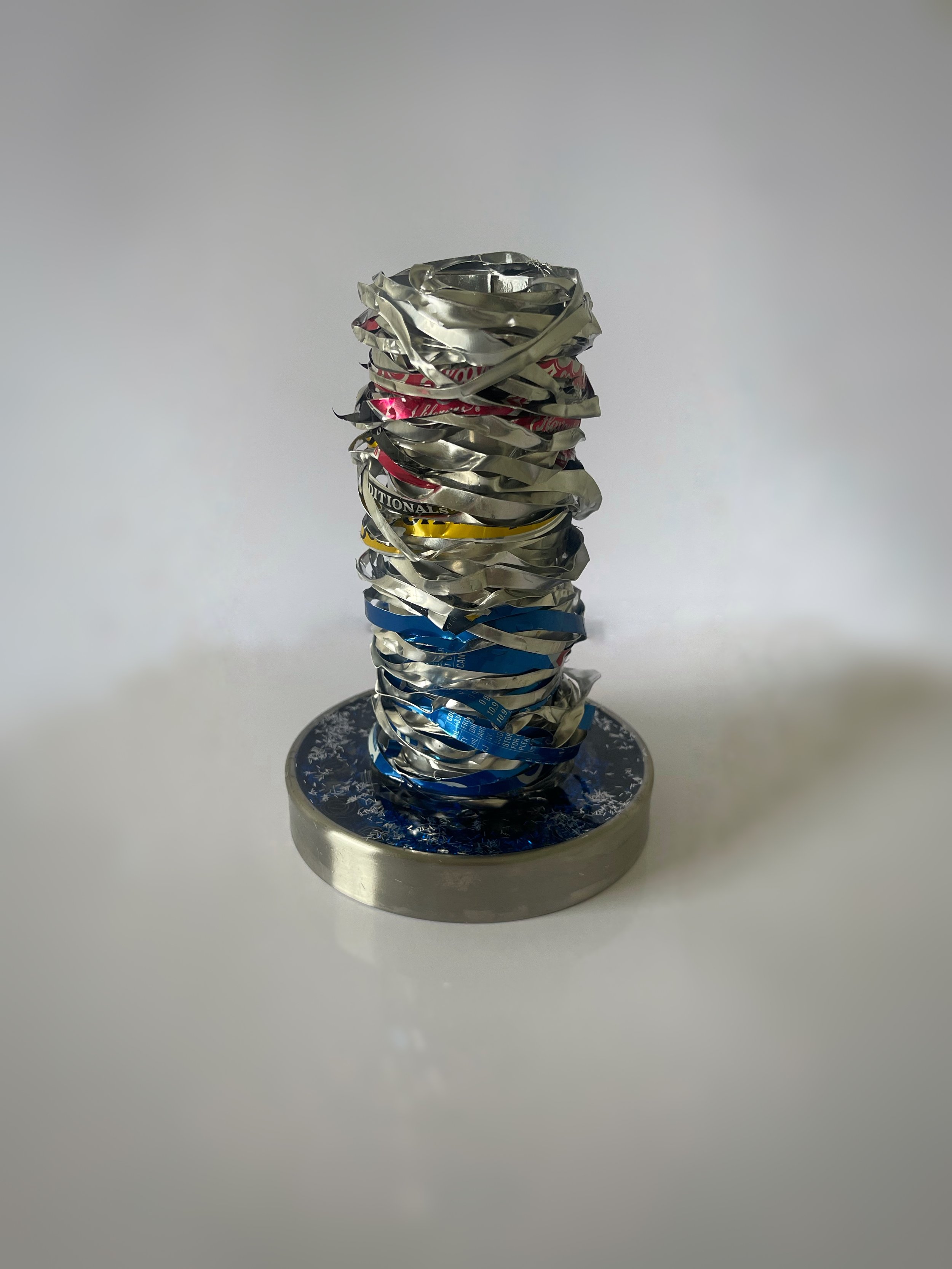
Aluminum, tin, glitter, sand, resin.
15 x 10 x 10 cm. 15 x 10 x 10 cm. 15 x 8 x 8 cm.
About the artwork…
My sculptural practice repurposes and reimagines found objects and materials with a focus on human impact on the environment. The work Vessels, which consists of a series of small manipulated and embellished aluminium and tin repositories, reflects on the relationship between human and object, and natural and constructed.
About the artist…
Catherine Phillips is a Tasmanian born artist who works in painting, sculpture, installation. In 2019 she graduated with a Master of Fine Art research degree which explored the human relationship with the natural world through art process and materials. She has also completed a Master of Teaching (Visual Art), a Bachelor of Contemporary Art with Honours, a Bachelor of Philosophy and a Grad. Cert. in Public Art. She has participated in multiple solo and group exhibitions, has been a finalist in several art prizes and her work is held in local commercial and private collections.

ANEIZYA CAPERIDA, 2022
Clay, Aluminium can.
9 x 13 x 13 cm.
About the artwork…
Art of the ancient and modern world; materials naturally sourced, yet never combined. Our bodies during biblical times were likened to clay jars: vessels, delicate and perfectly imperfect masterpieces. Entering womanhood; a wave of identity, emotion, value and growth often disencumbers our minds of our supposed worth. As much as our new world attempts to incorporate our human ways with technological and modern ways, we will never amalgamate. Our original purpose was to be filled with content, euphoria and motivation. Our new world has created systems of attacking our earthly-bound bodies, creating stereotypes and expectations unrealistic to achievement. In this artwork, I have used clay, an earthly material, to envision a human body. You will see iron being stabbed into this “body”, representing the way our modern world has attacked us, sometimes leading to the acceptance of the deletion of our natural human behaviour. Clay and iron: beautiful but divided.
About the artist…
Aneizya Caperida, a grade 10 student based in North-West Tasmania. As a sixteen year old, she noticed that developing into a woman, a stage everyone seemed to be fond of, was not as easy as it seemed, especially with the influence of social media and trends that seem to be “the right way of life”. After her newly discovered love for pottery, she decided to incorporate clay and the theme of the art exhibition to illustrate her opinions on growing up in the twentyfirst century. Her goal is to show that her clay vessel, along with many of her artworks, like humans, are imperfect, yet still beautiful in their own way.

GRIETA BOSVELD, 2022
Food tins, Metal spoons, clock, bolts, metal rods.
21 x 11 x 19 cm.
About the artwork…
My artwork depicts a cat made from recycled food cans and metal. Like all beings, deep within itself, it is sustained by a mechanism - a clock - giving it life. Each tick of the clock hand symbolizes a heartbeat. Each heartbeat a breath. And though life’s clock skips ahead sometimes, or perhaps, even falls behind, it still is alive. Even in each simple creature, breath is there - the essence of life is present.
About the artist…
Grieta is a grade nine student at North West Christian School, located in Penguin. She enjoys art, especially painting and sketching. Recently, the grade nines, along with the grade tens, were looking at how to create sculptures from metal food cans. The class looked at several examples of sculptures created by other artists who had taken part in Ross Tin Can Exhibitions in the past, in order to gain inspiration before embarking to work on their own projects.

SUSAN MCARTHUR, 2022
Aluminium cans, millinery wire, copper wire.
54 x 45 x 45 cm.
About the artwork…
Amidst a flourish of flower and a busy buzzing of bee, I suddenly spy a creature unbeknown to me. Balanced on a daisy waving in the wind, a beautiful orange glow beneath translucent wing. A long gangly leg tentatively grips while into a pool of nectar a probing proboscis dips. Initial thoughts of a stinging barb are soon put to rest when I discover an ichneumon wasp, the one without a nest. Her solitary flight to pollinate, her ovipositor to propagate. She is unique to our Isle and as she sups we shall smile.
About the artist…
Susan McArthur has been operating a millinery business in Burnie for 25 years. Whilst undertaking a Master of Contemporary Arts degree at UTAS in 2010, Susan began using metal to inform the hat. In 2011 Burnie Regional Art Gallery held a solo exhibition of her works entitled Capturing the Hat. As a milliner of some 30 years Susan’s creations have been exhibited in boutiques throughout Australia and on race courses around the world. In 2012 her copper wire headpiece, rendered in photography, won the Tasmanian Women’s Art Award Material Girl. In 2016 MONA - Museum of Old and New Art commissioned a hat for the exhibition Hound in the Hunt. In 2018 Susan was invited to create a hat for exhibition in London Hat Week. Currently she has a display of wire works at The Hive Cultural Precinct in Ulverstone. As a wearable form of sculpture this headpiece and stand is designed to; explore the use of materials, evoke movement and light, enhance the beauty of nature and embrace a sense of the exotic.

ZANNAH ACKLAND, 2022
‘the lil’ one’ baked bean cans, square metal rods and hot glue.
21 x 37 x 43 cm.
About the artwork…
Life’s biggest problem is making decisions; I’m not great at them, but the one tip I can offer is to observe the situation from every angle and take several steps back (the more the better). The thing about sustainability is its meaning has been skewed in recent years. What choices will we make today? How will they affect tomorrow?
This artwork is symbolic of the struggle with sustainability. Initially I attempted to weld the cans to the frame, when you look closely, you’ll see this plan had a few holes (as initial plans can). Then I tried the much easier route of hot glue. Although it didn’t initially stick (as good plans sometimes don’t), it proved beneficial to the final, successful method of welding the uprights and cans very cautiously and touching up with paint (eventually you reach the goal).
About the artist…
“I just love the beautiful expanse of nature I live surrounded by.” Zannah was born in Queensland but moved down when she was just three and a half, to 72 acres of land in Wilmot. She learned early on to appreciate the picturesque mountains and the joy of living almost untouched by civilisation. Since Zannah was very little she loved puzzles and making things. In Year 9 she took Art class, just to try it and to avoid learning a language on Duolingo. For the first time ever, she loved the freedom of creating and feeling. Since then, Zannah took Art class again in Year 10 and has created a few paintings, some clay vessels, a junk sculpture, and part of a wall mural.

ELANA TUAOI, 2022
Tin cans, tape.
10.5 x 5 x 5 cm.
About the artwork…
My artwork explores and focuses on humans and their emotions. I used two food cans for my artwork. Many people are emotionally suffering and are in pain but hide what they’re experiencing behind a smile or brave expression. The first can is painted green with a yellow smiley face while the other is painted black with a red sad face. The first can represents a person’s happiness, while the other represents what the person is actually
feeling inside. On the back of both cans there are holes. Inside the can, I used cellophane so that when the light shines through the holes and cellophane the colour of the light changes. These colours represent happiness and sadness. My artwork is a constant reminder that we do not need to hide the suffering we experience. Being honest with your feelings can lead to positive mental health and well-being. This will help us in growing emotionally and mentally.
About the artist…
Elana is a student in grade nine at North-West Christian School that is in Penguin. She enjoys painting and sketching although she isn’t the best at it. Her class has recently been making sculptures from metal food cans. For inspiration the grade nine class along with the grade ten’s looked up examples of tin can sculptures as well as looking at some from previous sculptures at the Ross Tin Can Exhibition.
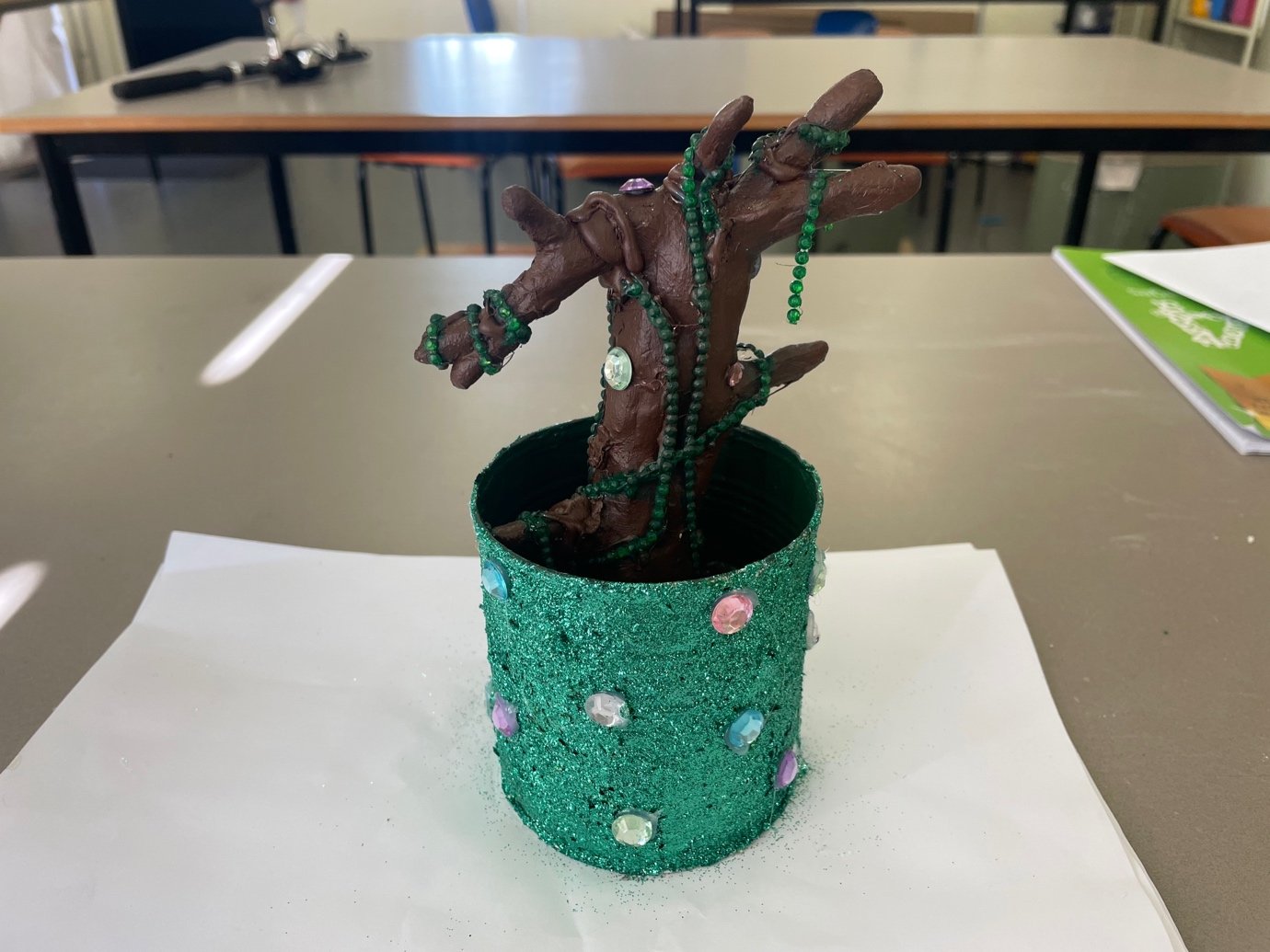
ABI-JEAN HENDRY, 2022
Tin can, Clay, Gems, paints, Glitter.
17 x 8 x 8 cm.
About the artwork…
My artwork conveys the beauty of wildlife and how we take it for granted. Frequently referencing the Amazon Rainforest and visually presenting how beautiful nature can be. The original concept of my design was to be a tree with flowing leaves that glow that perpetuated the idea that the wilderness is breathtaking, though I decided to make it simple by designing a tree of clay with gems and glitter. The tin that holds the tree resembles the tree’s life, decorated with big and small, colourful gems with green glitter surrounding the whole tin. Inside holds the tree that was sculpted with clay and painted dark brown with gems portraying green, vibrant vines and beautifulness. I hope to convey the beauty of nature and how delicate it can be, while we as humans should take a better understanding of how important nature is to not only ourselves but to animals.
About the artist…
Abi-Jean Hendry was born in Glasgow, Scotland, to an Irish-Scottish catholic father and a Welsh-Irish mother. Abi is currently a student who is in 10th grade at North West Christian School and regularly enjoys creating artwork. Abi was heavily influenced by the Amazon Rainforest when creating her tin artwork and hasn’t had much experience with art. Abi mostly enjoys creating abstract art and clay work and once won an award for her art piece in Burnie, coming 2nd in the whole of the city.
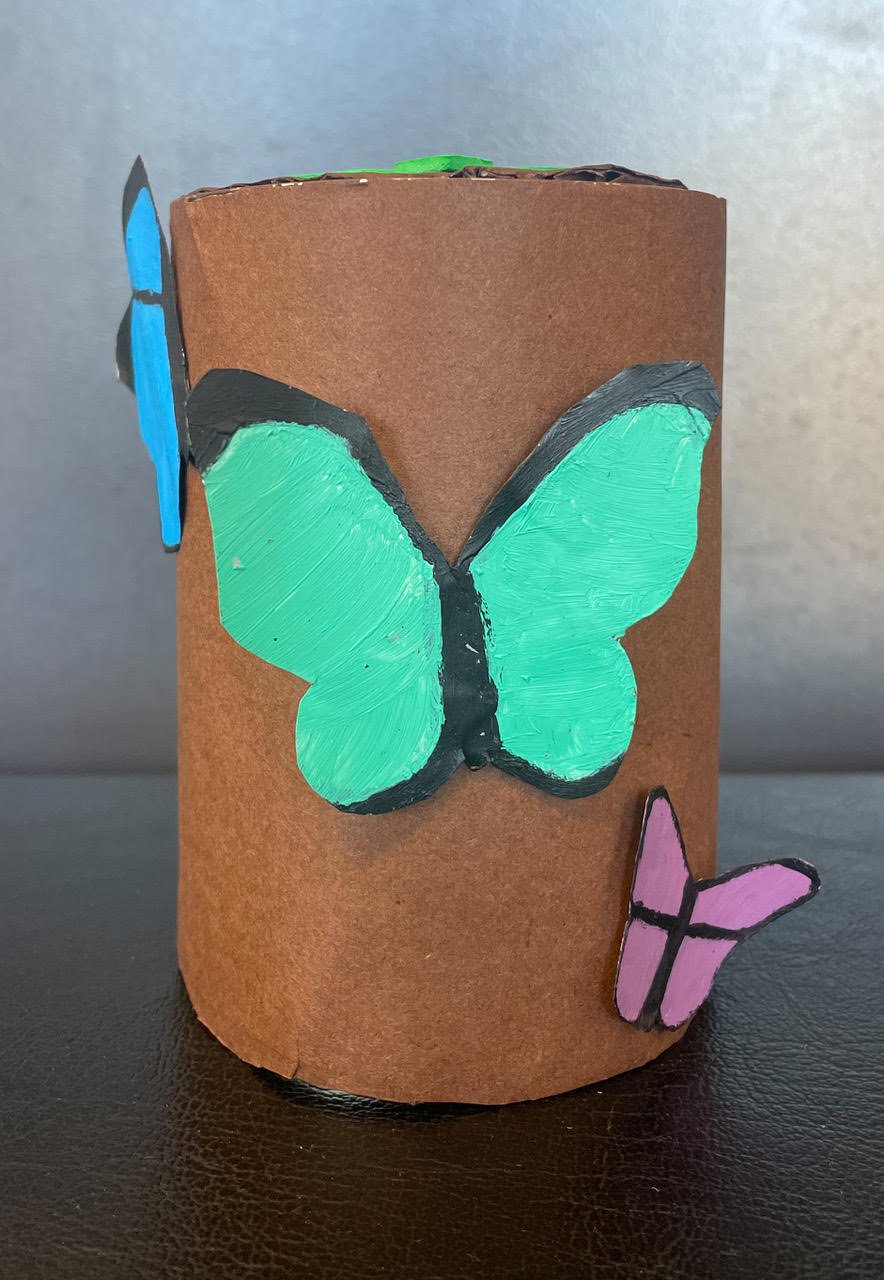
AVI HENDRY, 2022
Brown Paper, Acrylic paint, numerous tin cans.
11 x 7 x 7 cm.
About the artwork…
My work explores the work of butterflies in our fast paced world designed for humans. I aim to visually represent the life of a butterfly via a tin can. I used an old food can for the base of my work. I glued brown paper to the exterior of the can and used brown paint on the inside to look like a tree trunk. I then used another tin can to produce butterflies, which I painted using acrylic paints. I used hot glue to ensure the butterflies would stick to the can. I then used green leaves so the primary tin can would look like a tree. The butterflies sticking to the can aims to represent a butterfly’s repose.
About the artist…
Avi Hendry attends North West Christian School as a grade 9 student. She was born in North Hobart, Tasmania to Welsh and Scottish parents. Her preferred materials include various types of clay and acrylic paints. Avi hopes to convey serious concepts through simple pieces. She enjoys artistic challenges and experimenting with new concepts to produce new ideas.
Shop the Ross Tin Can Sculpture Show 2022
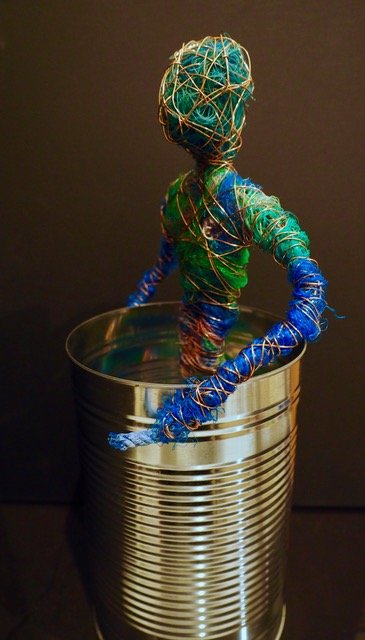
Anita Denholm, 2022
Large ‘tin’ Coffee Can, Recycled copper wire, Reclaimed plastic rope, Plastic toys, Resin.
40 x 20 x 20 cm.
About the artwork…
Art as Activism.
(A cynics view!)
Reaction to the current sad state of our Oceans and the rampant consumerism of our current lifestyles.
Discarded plastics all collected from the beaches of Cocos Keeling Islands (CKI-AUS) Situated in the northern reaches of the Indian Ocean- the islands are the most isolated, inhabited, island group in the world!
Many eastern facing beaches are littered with plastic and rubbish not generated by the Islanders- it comes as a result of rubbish going into waterways around the planet- and washing up on CKI We are consuming our resources at a great rate of knots, -polluting the seas, waterways and Oceans with the cast offs from consumption- soft drink bottle caps, fishing nets, ropes, toys, thongs, ciggie lighters, disposable nappies to name a few...
Our food is packaged in plastics, Our lifestyle rely on plastics, petrochemicals….
Plastics are found in the whole length and breadth of our World, found in large quantities on the beaches and oceans. We even have micro plastics found in our bodies, food, air, water and soils.
The figure is comprised of plastics from CKI, wire stripped from end of life electrical consumer items.
The coffee can represents our reliance on instant everything- just add water.
Look into the can to see small objects washed up on the beaches of CKI.
Art as Activism- how to raise the profile of the Plight of Our Oceans?
Make Art with a message- out of the very objects which are choking our planet and Humanity.
This is one in my series of small scale sculptures broadly titled ”On Consideration Of Our Oceans” which hold with the following raison d’être-
“Seeking to raise awareness to the Plight of Plastics- For the Sake of Our Oceans Future and Our Future Generations”
Thank you for your “Consideration Of Our Oceans”

MIKAYLA BEATY, 2022
Soccer Ball, Spray paint, soda cans, fishing line.
52 x 52 x 52 cm.
About the artwork…
Life – it brings about unexpected beginnings and ends, for ours at the moment, it was and in some cases still is the rise of the Covid-19 virus. Coronavirus was not a scare, till one morning we woke up to lives fading away, our communities ailing and stereotypes being generated. It has brought about a lot of world-wide pain and the questions of how, who, where, when and why? And an answer for those questions, in short, is because this virus is a monster. Everyone affected by this virus has a different story, and my story is my own.
About the artist…
Mikayla Beaty is a 15 year old Year 10 student attending North-West Christian School located in the coastal Tasmanian town of Penguin. Mikayla based her art piece on the fact that she grew up surrounded by the outdoors of the Mount Roland range, loving the freedom of fresh air, until unfair circumstances confiscated that freedom – the Covid -19 lockdowns. Mikayla’s family has been dealing with the ‘consequences’ of the free choices that her mother, who is a small town GP. Mikayla’s experiences throughout this pandemic and childhood memories shape this artwork.